How Work Really Gets Done
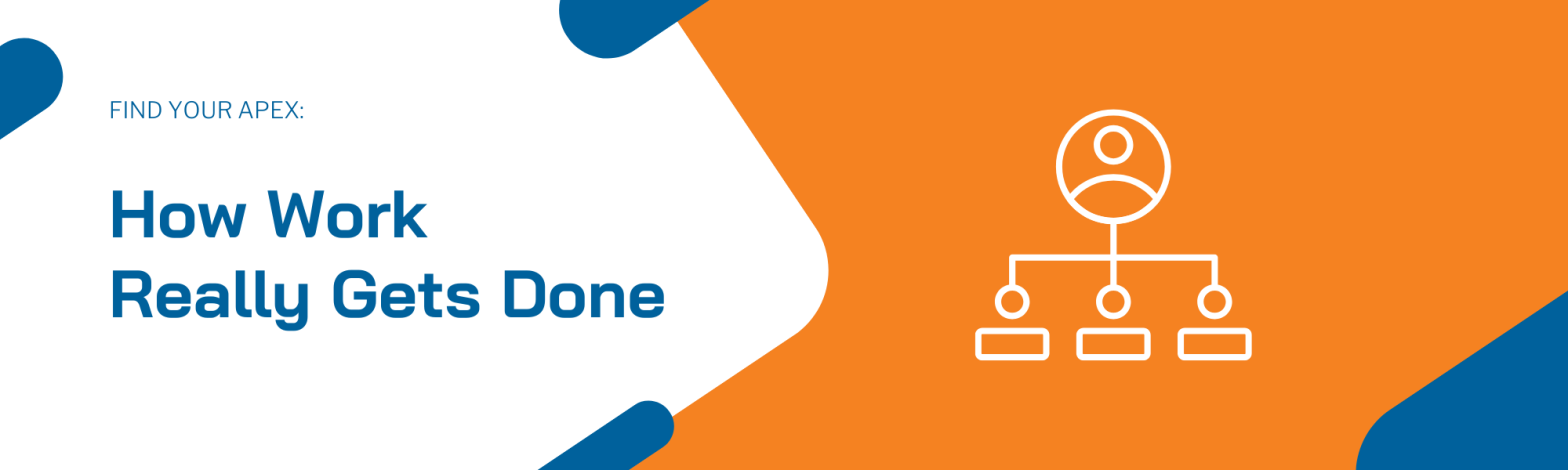
I have always loved org charts.
And I mean always.
When I was little, I used to make them for fun while tagging along to work with my grandma and my aunts. There was something about seeing people and roles mapped out that fascinated me. Who was responsible for what? How did the pieces fit together? Where did decisions sit?
Apparently, organizational design found me pretty early.
I still love a good org chart.
When one is thoughtfully designed, it can bring a surprising amount of clarity to an organization. You can see reporting relationships, functional responsibilities, leadership layers, and where accountability is intended to sit.
But after years of working inside growing companies and with leadership teams navigating change, I’ve learned not to confuse the org chart with the organization itself.
The chart shows me the structure leadership intended.
Then I want to know how the work actually gets done.
There’s Usually Another Organization Hiding Behind the Chart
Walk into almost any business and ask people how something really happens.
You’ll learn quickly.
The process may say one thing, but everyone knows they need to call a particular person first.
A customer issue technically belongs to one department, but three other people are involved before it gets resolved.
A manager appears to own a decision, but everyone knows the CEO is still going to weigh in.
Someone has a spreadsheet on their desktop that quietly holds together a process the official system doesn’t handle very well.
None of those examples automatically means something is wrong.
Organizations are human systems. People adapt. They build relationships. They find faster ways to solve problems.
I actually expect some of that.
What interests me is when the workaround stops being occasional and becomes the way the business operates.
That’s useful information.
Growth Changes How Work Moves
When a company is small, a lot of coordination happens naturally.
People know what everyone else is working on. They overhear conversations. The owner can answer a question quickly. If something goes wrong, the right people are usually within a phone call or a few steps of each other.
Then the business grows.
You add people because you need specialization. You create departments because the work has become more complex. You add managers so every decision doesn’t have to run through one person.
All of that makes sense.
But now there are more handoffs.
Sales needs something from operations. Operations needs finance involved earlier. HR needs managers to provide information on time. Customer service needs visibility into promises that were made before the client ever reached them.
Those connections are where organizational design either starts working beautifully—or starts creating drag.
And you can’t see most of them on an org chart.
I Pay Attention to Handoffs
If I’m trying to understand an organization, one of the first things I want to know is where work changes hands.
Take client onboarding.
Sales closes the relationship. Then somebody has to communicate what was sold, what was promised, timing, pricing, special circumstances, and what the client expects next.
Who owns that transition?
What information has to move with it?
At what point does operations officially own the relationship?
When does finance get involved?
What happens when something is incomplete?
When those answers are fuzzy, people compensate.
Sales follows up repeatedly to make sure nothing was missed. Operations creates its own checklist. Finance discovers something after the fact. A leader gets copied on everything because everyone feels safer when someone senior is watching.
Suddenly, a process that should move fairly cleanly requires a lot of organizational energy.
That’s not necessarily a people problem.
It may be a design problem.
The Person Everyone Depends On Is Worth Looking At
Another thing I notice quickly is the person everyone calls.
Most organizations have one.
They know how things work. They remember why a decision was made three years ago. They know who needs to be involved. They can get around a broken process faster than anyone else.
These people are often incredibly capable and incredibly helpful.
They can also hide structural problems.
If a process only works because one person knows how to navigate it, the organization doesn’t really own that knowledge. The individual does.
That creates risk.
It also creates a tremendous burden for the person who has become the unofficial connector for the company.
One of the questions I like to ask is simple:
If this person were unavailable for two weeks, what would stop moving?
The answer tells you quite a bit.
Recurring Friction Is Trying to Tell You Something
Every organization has frustrating days.
A deadline gets missed. Someone forgets to communicate. Two people misunderstand each other.
That’s work.
I’m more interested in what keeps happening.
The same decision is escalated every month.
The same two departments are frustrated with one another.
The same leader is overwhelmed because everything seems to land on their desk.
The same information is repeatedly missing at the same point in a process.
At some point, it’s worth stopping the individual fixes and looking for the pattern.
We’re often quick to say someone needs to communicate better or be more accountable.
Maybe.
But maybe the role isn’t clear. Maybe decision authority never shifted as the company grew. Maybe two departments have overlapping responsibilities. Maybe a process designed for a 30-person organization is still being used with 100 people.
Friction isn’t always something to push through.
Sometimes it’s diagnostic.
Before You Move the Boxes, Follow the Work
When leaders feel organizational strain, the natural reaction can be to reorganize.
Move this role over here. Add a director. Change a reporting relationship. Create a new department.
There are absolutely times when those changes are needed.
I just don’t like starting there.
Before I redraw anything, I want to follow the work.
Pick an important process and walk through it from beginning to end.
Who touches it?
Where does it wait?
Where does information get lost?
Where do people have to ask permission?
Who gets pulled in even though the formal structure says they shouldn’t need to be involved?
Where are people relying on relationships instead of a repeatable process?
Now we’re getting somewhere.
A new box on an org chart might be part of the answer. But we understand why we’re changing it.
The Org Chart Should Evolve With the Business
One reason I enjoy organizational design is that there is no permanent answer.
The structure that helped a company reach one stage of growth may be exactly what creates limitations at the next one.
Responsibilities change. Leaders develop. New capabilities become necessary. Decision-making needs to move. The founder’s role evolves.
The organization should evolve too.
The Stages of Growth Matrix is one tool we use to help leaders think about this. Different stages bring different kinds of complexity, and that complexity changes what the organization needs from its structure and leadership.
Sometimes what feels like a people issue is really the business telling you it has outgrown the way the work was organized.
The Apex Perspective
I will probably always enjoy pulling up an org chart and looking at how an organization is designed.
But the chart is the beginning of the conversation for me, not the end.
At Apex GTS Advisors, our work through Organizational Transformation & Alignment looks beyond reporting relationships and asks whether the organization’s structure, responsibilities, and operating practices actually support what the business is trying to accomplish.
Our Apex Planning Guide takes a similar approach. Good planning starts with understanding the organization as it really exists today, not the version we assume exists because that’s what the chart says.
So yes, build the org chart.
Make it clear. Keep it current. Use it to create accountability.
Then get out of the boxes for a while.
Talk to people. Follow a piece of work. Watch where decisions go. Notice the workarounds and the relationships holding things together behind the scenes.
That’s where you start seeing the organization you actually have.
And that’s the organization you need to design for.